
Visegrad Group Revives North-South Infrastructure Push in 2026

Reporting from Bratislava, the Visegrad Group (V4) nations of Czechia, Hungary, Poland, and Slovakia are recalibrating their strategic infrastructure priorities in 2026, with a pronounced emphasis on a North-South transport and energy corridor. This renewed focus, articulated in the 23 June 2026 Joint Statement by the four prime ministers, signals a significant policy shift aimed at enhancing regional competitiveness and energy security. The leaders have mandated their respective ministers to identify concrete joint cooperation opportunities by the end of 2026, with a particular eye on innovative financing mechanisms for these multi-country undertakings. This directive sets the stage for a wave of cross-border infrastructure projects, moving beyond the traditional east-west orientation that has historically dominated European connectivity discussions.
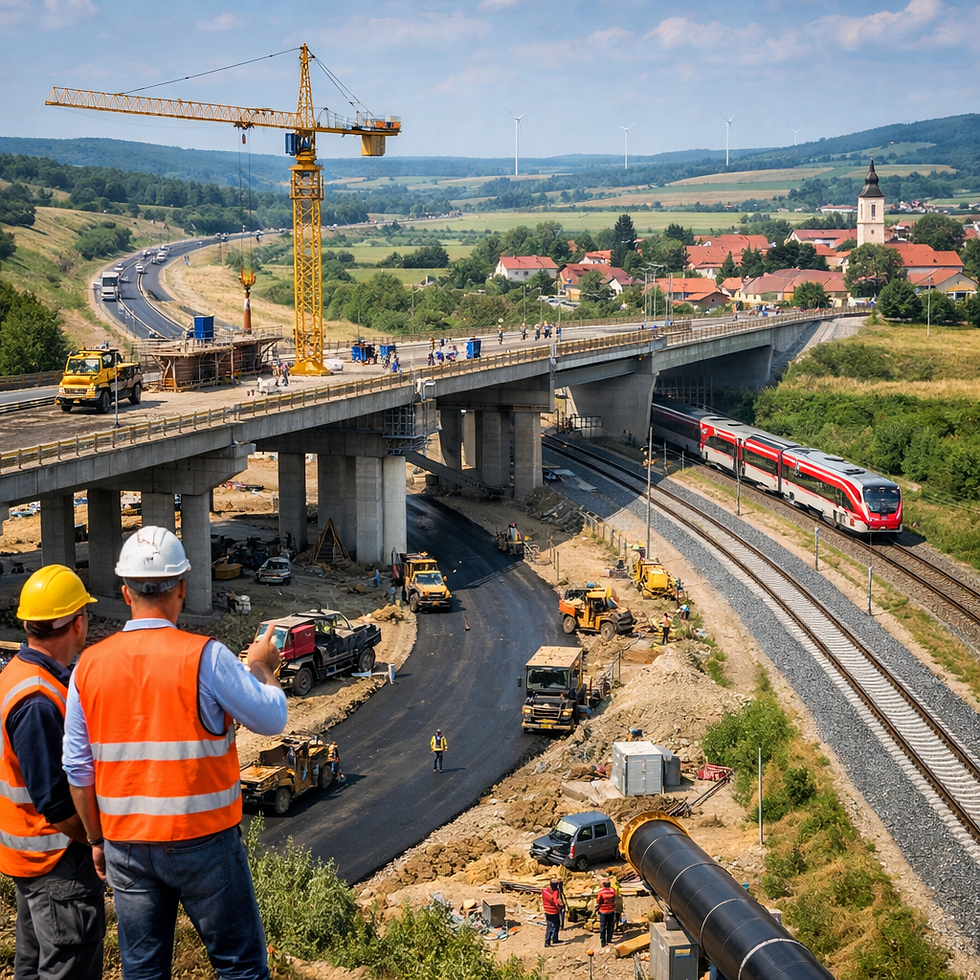
The political impetus for this North-South axis revival is rooted in broader economic and geopolitical considerations. Discussions within the V4 framework in 2026 also encompass pressing issues such as energy prices, the ongoing revision of EU climate and trade policies, and the negotiations surrounding the next EU multiannual financial framework. These interconnected challenges underscore the V4's recognition that robust, integrated infrastructure is not merely a matter of convenience but a fundamental component of industrial resilience and economic stability. The Slovak Presidency of the Visegrad Group, active throughout 2026, is serving as the institutional linchpin for these discussions, actively pushing for advancements in key transport corridors, TEN-T connectivity, and railway modernization.
Visegrad Group North-South Transport Corridor Development
The V4's explicit political line in 2026 prioritizes the development of a North-South transport spine, a deliberate move to complement and strengthen existing east-west links. This strategic reorientation aims to create a more balanced and resilient regional network, crucial for trade flows and logistical efficiency across Central Europe. A key element of this ambition is the proposed high-speed rail connection linking the capitals of the four member states: Budapest, Bratislava, Prague, and Warsaw. This ambitious project, often referred to as the V4 High-Speed Railway, represents a substantial commitment to modernizing the region's rail infrastructure.
Planning for this high-speed rail network is already showing concrete financial signals. A March 2026 report detailing Slovakia’s high-speed rail planning indicated an estimated investment exceeding EUR 3 billion for the VRT V4 cross-border high-speed railway project within its borders. This figure, while significant, points to the scale of capital expenditure required for such a complex, multi-national undertaking. The project is envisioned as a mixed evolution path, suggesting a phased approach that could involve both new construction and upgrades to existing lines to meet high-speed standards. Such projects will require extensive engineering, civil works, and systems integration expertise, creating substantial opportunities for international contractors. TendersGo, with its extensive database covering 220+ countries and all sectors, will be a critical resource for tracking prequalification notices and subsequent tender releases related to these rail developments across Czechia, Hungary, Poland, and Slovakia. Interested firms can set up unlimited alerts on app.tendersgo.com using CPV codes for railway construction, signaling, and civil engineering to stay abreast of emerging opportunities.
Beyond high-speed rail, the Slovak presidency program for 2026 also emphasizes broader railway modernization and expansion, including the implementation of European Rail Traffic Management System (ERTMS) safety systems. These initiatives are directly aligned with the broader Trans-European Transport Network (TEN-T) corridors, ensuring that V4 infrastructure development is integrated into the wider EU network. The focus on TEN-T alignment suggests that these projects will adhere to EU technical specifications and procurement guidelines, potentially opening doors for a wider range of European and international suppliers. Procurement for ERTMS, for instance, involves specialized signaling and control systems, requiring vendors with proven experience in advanced rail technology. The cross-border nature of these upgrades means that consortia with expertise in multi-jurisdictional project management will be particularly well-placed to compete.
Visegrad Group Energy Infrastructure Cooperation and Security
Parallel to the transport initiatives, the V4 political agenda for 2026 equally prioritizes energy infrastructure development, framing it as an integral component of a combined corridor and security strategy. This reflects the lessons learned from recent geopolitical events, underscoring the critical need for diversified and resilient energy supply routes. The North-South gas corridor stands out as a successful precedent for V4 cooperation in this domain, having effectively connected gas pipeline systems across the region and reduced reliance on single-source suppliers. This legacy provides a blueprint for future energy integration efforts.
The region's energy integration is built upon a network of interconnectors, which are now slated for further reinforcement and expansion. Examples include the Poland–Slovakia Interconnector, which boasts a substantial capacity of 5.7 billion cubic meters per year (bcm/year) towards Poland and 4.7 bcm/year towards Slovakia, and the Slovakia–Hungary Interconnector. These vital links facilitate bidirectional gas flows, enhancing energy security and market flexibility for all V4 members. Future tenders related to these interconnectors could involve pipeline construction, compressor station upgrades, and metering equipment, attracting specialized engineering and construction firms.
Looking ahead, regional energy discussions in 2026 increasingly reference the Central European Hydrogen Corridor (CEHC), an initiative supported by Transmission System Operators (TSOs) such as NET4GAS and Eustream. Designated as an EU Project of Common Interest, the CEHC aims to establish a hydrogen backbone across Central Europe, facilitating the transition to cleaner energy sources. This project signifies a forward-looking approach to energy infrastructure, moving beyond traditional fossil fuels to embrace emerging technologies. Procurement opportunities arising from the CEHC will likely include feasibility studies, engineering design for hydrogen pipelines, compressor technology suitable for hydrogen, and potentially electrolyzer infrastructure. International firms with expertise in hydrogen production, transport, and storage technologies should monitor the progress of this initiative closely, as it represents a significant long-term investment in regional energy infrastructure. TendersGo’s sector-specific filters on sectors.tendersgo.com allow users to pinpoint tenders related to energy infrastructure, gas pipelines, and hydrogen technologies, ensuring no opportunity is missed.
Financing Mechanisms and Implementation Structures
The June 2026 Joint Statement from the prime ministers of Czechia, Hungary, Poland, and Slovakia provides a clear intergovernmental mandate for these infrastructure initiatives. This high-level political backing is crucial for driving cross-border projects that often face complex legal and administrative hurdles. The leaders have specifically tasked their respective ministers with identifying joint projects and exploring new forms of financing by the end of 2026. This implies that the immediate implementation layer will involve line ministries responsible for transport and energy, working in coordination across national borders.
The search for "new forms of financing" indicates a willingness to look beyond traditional national budgets and EU structural funds. While the specific financing package is not yet finalized, discussions are likely to involve a blend of EU instruments, national co-financing, and potentially private sector investment through public-private partnerships (PPPs). The European Investment Bank (EIB) and the European Bank for Reconstruction and Development (EBRD) are also potential partners, given their long track records in financing large-scale infrastructure projects in the region. The approximately EUR 3 billion estimated investment for Slovakia’s high-speed rail planning alone highlights the need for robust and diverse funding sources.
The Slovak Presidency of the Visegrad Group is acting as the primary coordinator for these efforts in 2026, facilitating discussions on rail modernization, the high-speed rail project, and TEN-T connectivity. This structured approach ensures that the political impetus translates into concrete work plans and coordinated action. While the material available does not yet identify specific project numbers from development banks like the World Bank or EBRD, this is consistent with the current stage of political coordination and project shaping. Formal multilateral lender engagement typically follows the detailed identification of projects and the design of financing structures, which is precisely what the V4 ministers are tasked with completing by year-end.
Cross-Border Procurement and Tender Implications
The 2026 policy reset within the Visegrad Group strongly indicates a forthcoming pipeline of tenders, particularly in sectors critical to the North-South corridor. While specific 2026 tender deadlines are not yet publicly detailed, the ministerial mandate to identify projects and financing by end-2026 suggests that initial procurement activities will likely emerge in the areas of feasibility studies, engineering design, and framework agreements. International firms specializing in rail engineering, signaling systems, ERTMS implementation, corridor studies, interconnector construction, grid reinforcement, and hydrogen-ready infrastructure should prepare for these opportunities.
High-speed rail and major corridor projects, by their very nature, involve complex procurement processes, often requiring prequalification. This will be especially true for multi-country packages that demand seamless integration across national interfaces. Rail operators, civil contractors, systems integrators, and energy Transmission System Operators (TSOs) with demonstrable experience in large-scale, cross-border projects will find themselves well-positioned. The emphasis on TEN-T alignment and EU standards means that bidders must be familiar with European procurement directives and technical specifications. Firms can utilize TendersGo’s advanced search capabilities to filter for tenders by country (Czechia, Hungary, Poland, Slovakia) and by CPV codes relevant to their expertise, ensuring they receive timely alerts for upcoming prequalification and tender notices.
For example, the deployment of ERTMS across the V4 rail networks will generate tenders for specialized signaling equipment, software development, and installation services. Similarly, the development of the Central European Hydrogen Corridor will require expertise in pipeline construction, compression technology, and potentially hydrogen production facilities. These are not merely national projects but integrated regional initiatives, demanding a collaborative approach from contractors and suppliers. The expectation is that procurement will be structured to encourage international participation, fostering competition and bringing in advanced technologies and best practices from around the globe.
Regional Competitiveness and Strategic Outlook for 2026
The Visegrad Group’s renewed focus on North-South infrastructure in 2026 is fundamentally driven by a desire to bolster regional competitiveness and address pressing economic challenges. By improving transport links, particularly through projects like the V4 high-speed rail network, the region aims to enhance connectivity for businesses, facilitate faster movement of goods and people, and attract foreign direct investment. The integration of TEN-T corridors ensures that these regional improvements contribute to a more efficient and interconnected European single market. This strategic alignment can significantly reduce logistical costs for industries operating within the V4, making the region a more attractive hub for manufacturing, distribution, and services.
On the energy front, the continued development of interconnectors and the ambitious Central European Hydrogen Corridor are critical for ensuring energy security and accelerating the green transition. Diversifying energy sources and routes mitigates risks associated with supply disruptions and price volatility, which have been significant concerns in recent years. By investing in hydrogen infrastructure, the V4 nations are positioning themselves at the forefront of future energy markets, creating new industrial opportunities and fostering innovation. This forward-looking approach to energy infrastructure is directly linked to the broader discussions on EU climate policy and the region's industrial cost structures, demonstrating a proactive stance towards long-term economic resilience.
The end-2026 deadline for ministerial reports on identified projects and financing mechanisms marks a crucial juncture. This period will see intensive coordination between Czechia, Hungary, Poland, and Slovakia, shaping the specific scope and timeline of these multi-billion-euro initiatives. International contractors, export managers, and business development teams should closely monitor policy developments and ministerial pronouncements from these countries. Understanding the nuances of each nation's infrastructure development plans and their alignment with the overarching V4 strategy will be key to identifying and securing future opportunities. The commitment to explore "new forms of financing" also suggests an openness to innovative funding models, potentially involving private sector participation from early stages of project development. This comprehensive push towards a more integrated North-South corridor underscores the V4's strategic vision for a more resilient, competitive, and sustainably connected Central Europe.





