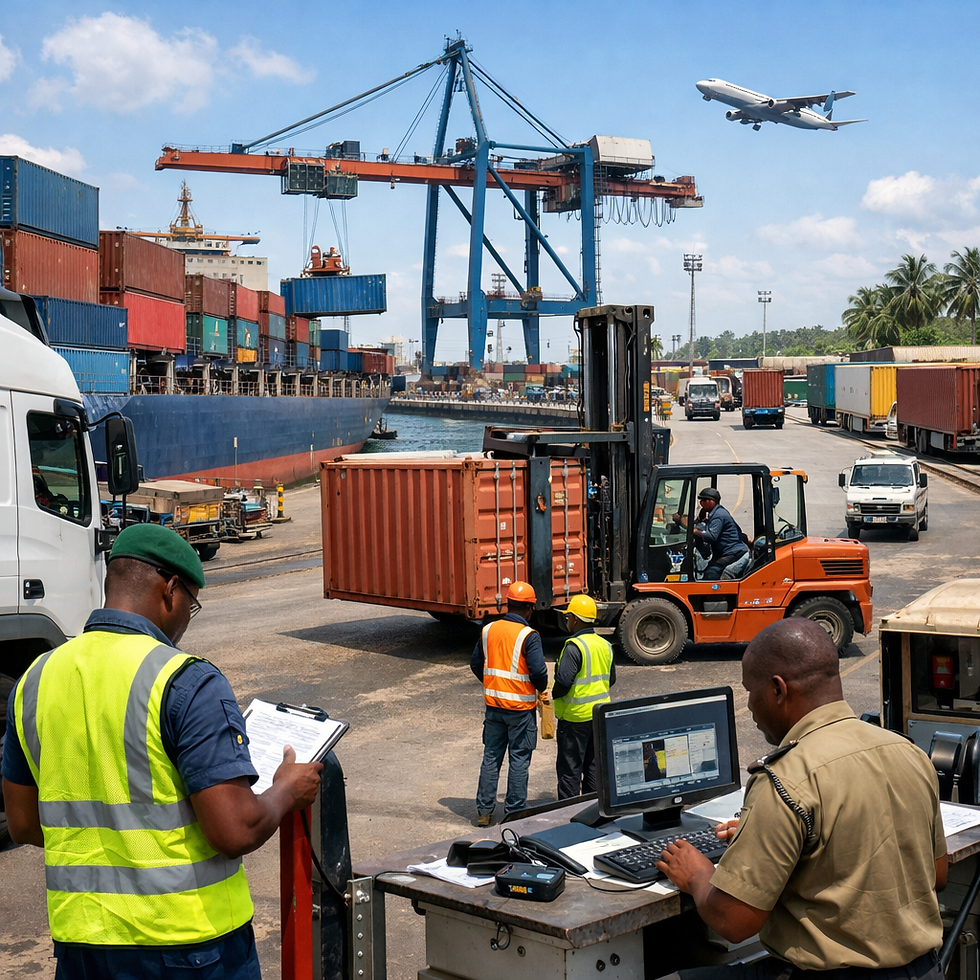
Africa’s New Trade Corridors Face a Logistics Squeeze

Africa's trade arteries, vital for the continent's economic integration under the African Continental Free Trade Area (AfCFTA), are experiencing a significant logistics squeeze in 2026. While investment in new infrastructure and corridor development continues, verified data reveals that persistent bottlenecks at ports, border crossings, and along inland transport routes are hindering the efficient movement of goods. This situation impacts international contractors, export managers, and development bank consultants seeking to capitalize on Africa's burgeoning trade opportunities. The issue is not solely a lack of physical infrastructure, but increasingly a complex systems integration challenge across multiple countries, demanding a nuanced approach to procurement and investment.

The World Bank’s recent corridor assessment for Southern Africa paints a clear picture: key trading corridors, despite improvements, still contend with missing links, limited inter-modality, and poorly performing nodes. Congestion around major cities and ports remains a structural impediment. The report highlights that approximately 67% of all cargo moving between regions in Southern Africa relies on a few critical links, rendering the entire network highly vulnerable to disruptions. For instance, the closure of the Port of Richards Bay or Cabinda would prevent the equivalent of 16,000 vehicles worth of cargo from reaching its destination, while Saldanha faces a similar impact for 7,000 vehicles. This low redundancy across the network means that disruptions, whether due to operational failures or external factors like Red Sea insecurity, can cascade rapidly, extending delivery timelines for East and Southern Africa and adding substantial surcharge pressure for import-dependent sectors such as manufacturing, retail, pharmaceuticals, food processing, and fertilizer.
Africa Trade Corridors 2026 Logistics Bottlenecks
Despite these persistent challenges, specific ports and corridors demonstrate tangible improvements in 2026, showcasing the potential of targeted modernization efforts. The Port of Dar es Salaam in Tanzania, a critical gateway to eight neighboring countries, reported cargo throughput reaching 27.7 million tons by May 2026, servicing nearly 1,990 vessels within that period. Crucially, container vessel turnaround time at Dar es Salaam improved dramatically from 10 days to 3 days. This significant reduction underscores the effectiveness of better integration between rail and port systems in alleviating congestion and streamlining operations, offering a blueprint for other regional ports. International contractors specializing in port logistics and rail infrastructure can find numerous opportunities here, particularly in the ongoing expansion and modernization of port facilities and their rail interfaces.
Further south, the Durban–North-South Corridor, identified by TradeMark Africa as the region’s busiest trade route linking Durban to Botswana, Zimbabwe, Zambia, and the DRC, also registered improvements. Vessel call durations at Durban decreased from 6.75 days in 2024 to 6.68 days in 2026. Heavy motor vehicle terminal processing times improved by nearly 8%, indicating progress in operational efficiency. These incremental gains, while encouraging, also highlight the sheer scale of the challenge. The North-South Corridor’s high traffic volume means that even minor inefficiencies can translate into significant delays and increased costs across multiple economies. Development bank consultants and business development teams should focus on identifying and addressing these specific friction points, which often involve a mix of infrastructure upgrades and operational reforms.
The 2026 data strongly suggests that Africa’s logistics challenge is evolving from a pure "lack of infrastructure" problem to a systems integration problem. Ports, rail networks, customs agencies, and border authorities are improving at varying paces, leading to continued cargo delays at handoff points. This uneven development necessitates a more integrated approach to procurement and investment. Contractors and suppliers looking for opportunities should utilize platforms like TendersGo , filtering by CPV codes related to logistics IT solutions, border management systems, and multimodal transport planning, to identify tenders issued by regional bodies and national agencies. The platform’s extensive coverage across 220+ countries and 145 languages ensures that nuanced regional opportunities do not go unnoticed.
Cross-Border Transport Africa Regional Trade 2026
Key projects and agencies are actively shaping the response to these cross-border transport challenges. In Tanzania, the Port of Dar es Salaam–Standard Gauge Railway (SGR) integration stands out as a prime example of corridor modernization. This initiative aims to improve direct freight movement to inland destinations, thereby reducing double handling and overall transport costs. Such projects create substantial opportunities for international firms specializing in railway construction, rolling stock, and integrated logistics solutions. The SGR’s impact extends beyond Tanzania, providing a more efficient trade route for landlocked neighbors like Rwanda, Burundi, Uganda, and the DRC, illustrating the regional benefits of national infrastructure investments.
Border post modernization is another critical area. In Zambia, the Nakonde One Stop Border Post (OSBP) advanced significantly in March 2026, with President Hakainde Hichilema commissioning its first phase. The ambitious target is to cut clearance times by more than half, a move that would dramatically improve trade flows with Tanzania. Such OSBPs are vital for reducing dwell times and associated costs, offering tenders for border management systems, customs technology, and civil engineering works. TradeMark Africa is also championing customs-to-customs data exchange among Zambia, Malawi, Mozambique, and Zimbabwe, alongside supporting digital trade systems like Mozambique’s e-Phyto platform. Mozambique’s e-Phyto system has already reduced phytosanitary certification time from up to 12 days to a mere 2–3 days, demonstrating how digital solutions can remove major trade bottlenecks without requiring new hard infrastructure. This highlights a clear procurement signal for IT services, software development, and digital transformation consulting.
The focus on digital solutions and improved coordination extends to Joint Border Committees, supported by initiatives like those at Forbes-Machipanda, which aim to enhance cross-border coordination. These efforts, while less visible than large infrastructure projects, are crucial for achieving operational efficiency. They signal demand for expertise in border management, customs procedures, and data analytics. International suppliers of security systems, scanning equipment, and integrated border control software will find a receptive market as more countries seek to digitize and streamline their border processes. Government procurement officials across the region are increasingly prioritizing solutions that offer rapid returns on investment through efficiency gains, rather than solely focusing on greenfield projects.
The regional trade and transport implications of these developments are profound. The corridor evidence suggests that Africa’s logistics challenge in 2026 is not a single failure point but a multi-node capacity problem. While ports are improving, inland clearance, customs data exchange, and rail-road integration remain weaker links. The Southern Africa corridor analysis specifically warns that low redundancy across the network means disruptions can quickly cascade, as few detours are available. This necessitates a strategic approach to investment that considers the entire supply chain, not just isolated segments. The continent is seeing an increase in dry ports, rail-linked logistics zones, and multimodal nodes, but their effectiveness hinges on the operational capacity of border agencies and corridor operators to keep pace. For Africa-wide trade policy, this means corridor infrastructure investment alone is insufficient unless paired with customs digitization, enhanced border coordination, and sustainable maintenance funding.
AfCFTA Corridor Infrastructure Investment Africa 2026
The procurement and investment signals for 2026 are clear: there is active demand for border-post upgrades, sophisticated digital customs platforms, and corridor observatories. These opportunities extend to rail-port integration projects and the development of multimodal logistics zones, rather than exclusively large-scale greenfield megaprojects. The TradeMark Africa initiatives, for example, imply ongoing implementation opportunities around border management systems, data platforms, and operating-model reforms for corridor agencies and customs authorities. This represents a shift towards smart infrastructure and operational efficiency, attracting a different set of international suppliers and consultants.
The Tanzanian case, with its successful Port of Dar es Salaam–SGR integration, suggests that investors should closely monitor Public-Private Partnership (PPP) style opportunities around port modernization, rail interface assets, and inland logistics distribution nodes. These projects often involve long-term concessions and require significant private sector expertise in financing, construction, and operation. Companies specializing in port operations, rail freight, and logistics park development will find fertile ground. Furthermore, the emphasis on systems integration points to demand for project management consultants with experience in complex, multi-stakeholder environments, particularly those involving cross-border agencies and diverse regulatory frameworks.
The most compelling insight from the 2026 data is that Africa’s corridor bottleneck is primarily a systems integration problem. The best-performing interventions are digitization, enhanced border coordination, and robust rail-port integration, as these strategies reduce delays more rapidly than capacity expansion alone. The weakest points remain border crossings, congested port access roads, and inland nodes with limited redundancy, especially evident in Southern Africa. For international businesses, this means focusing on solutions that address these integration gaps. TendersGo, with its comprehensive search capabilities, allows users to set up unlimited alerts for specific CPV codes or keywords related to "customs automation," "border management systems," or "rail-port logistics," ensuring they are immediately notified of relevant opportunities across the continent. Such targeted intelligence is invaluable for navigating the evolving procurement landscape and identifying where investment can yield the most significant impact on regional trade flows.
The regional intelligence section at continents.tendersgo.com provides detailed breakdowns of these trends, offering granular data on specific country initiatives and procurement pipelines. For instance, a search for "Zambia Nakonde OSBP tenders" or "Mozambique e-Phyto platform contracts" on search.tendersgo.com would quickly reveal ongoing and upcoming opportunities. The platform’s AI summaries and PDF viewer further assist in rapidly assessing the scope and requirements of complex regional tenders, enabling international firms to respond strategically to Africa's evolving trade and logistics needs. The future of African trade hinges not just on building new roads and ports, but on intelligently connecting the existing and planned infrastructure through effective policy, digital solutions, and coordinated operational frameworks.